


What is process engineering?
17/01/2020
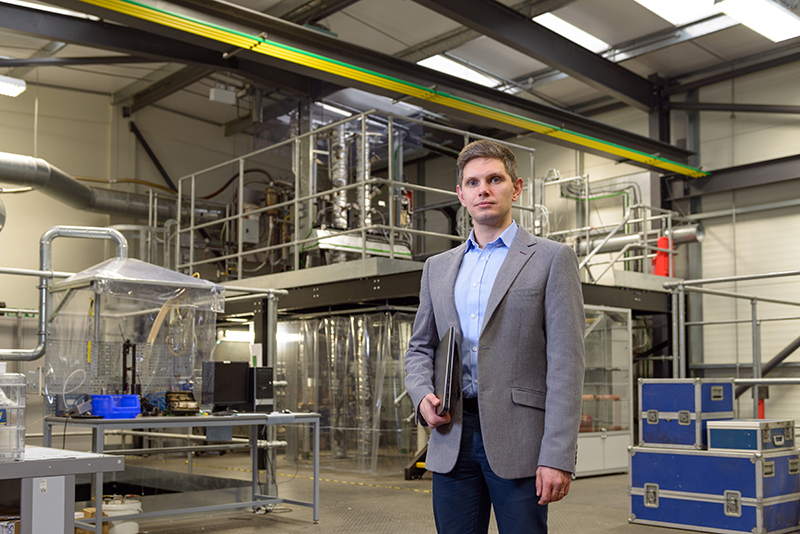
Process engineer – if you’ve been searching for an exciting career in engineering or STEM subjects, you must’ve come across this job title. But it isn’t always clear what the career in process engineering actually entails. As a process engineer myself, I’m often asked how does process engineering differ, for example, from chemical engineering or manufacturing engineering? Let me explain why it is exciting.
Process engineering plays a central role in our pursuit to tackle global challenges, such as climate emergency or water availability. As already stated in its name, this research area primarily focuses on any chemical, physical or biological process that aims to convert any raw materials into desired products. Therefore, process engineering has applications across energy and power, nuclear, chemical, petrochemical, water, food and drink, pharmaceutical, and many other industries.
You should remember that the process engineering is, however, a complex engineering specialisation. This multidisciplinary field is primarily based on chemical engineering, draws from environmental and mechanical engineering, and involves elements of economics and mathematics — it employes experimental techniques and systematic computer-aided tools throughout the process development cycle. The latter usually include process modelling and simulation, process economics, lifecycle assessment, and computational fluid dynamics. This implies that you don’t need a chemical engineering background to become a process engineer. Because process engineering is a cross-disciplinary field, the first degree that you need to become a successful process engineer can be in any engineering field related to energy engineering, environmental engineering, mechanical engineering, or even material science and chemistry.

Now that you know what process engineering is, let me expand on the role of a process engineer. Broadly speaking, their role is to design processes that will enable achieving a conversion of raw materials with maximised efficiency and profits, as well as minimised wastage of natural resources and environmental impact. In short, the designs need to be optimised with sustainability in mind. Sounds interesting, isn’t it?
Considering the responsibilities of process engineers, these can broadly focus on development, design, optimisation, debottlenecking, operation and control of any chemical, physical, and biological process, from carbon capture through hydrogen production to wastewater treatment and biorefinery systems. Working in multidisciplinary teams, process engineers can be responsible for a large variety of tasks. In summary, depending on the position focus and industry, the main functions can include:
- Research (design, integration, optimisation) and development of new process following the design specification;
- Design, development and installation of new equipment to improve the performance of the existing assets;
- Monitoring and evaluation of equipment and processes to ensure efficient operation of the process plant;
- Development of risk and environmental assessments to ensure the safe and environmentally-friendly design and operation of the asset;
- Management of budgets and leading teams to ensure that the projects are delivered according to the provisioned plan; and
- Analysis and presentation of data to key stakeholders, including senior colleagues and senior management.
Process engineering graduates are, therefore, among the most demanded engineers across multiple sectors, due to the flexibility of their skillset.
Now that I’ve explained what process engineering is and what process engineers do, another pertinent question is how does the job of a process engineer differ from that of a chemical engineer or manufacturing engineer. In my view, the main distinction between a process and chemical engineer is that the former do not derive new chemistry. They focus on innovation in the design of the equipment, layouts and integration of process plants to improve their efficiency, as well as reduce both environmental impact and operating cost. Such focus is also in contrast to the production or manufacturing engineers whose work focus on discrete machines, assembly lines, and manufacturing tools.
I hope that you now understand the benefits of becoming a process engineer! I trust that you have already found the opportunities to work across different industries and contribute towards solving global challenges appealing. To make it even better, the starting salary of a process engineer is between £29,000 and £32,000 and can increase to between £42,000 and £50,000 if you get over 5 years experience. This can get even higher if you become a chartered engineer! Finally, the demand for process engineers is expected to increase by 10-15% by 2026, especially among those in computer-aided process engineering. As this is faster than average for all occupations, it’s a great time to become a process engineer and solve global challenges via process engineering.

Categories & Tags:
Leave a comment on this post:
Comments are closed.
You might also like…

Keen to develop your study skills?
Alongside the technical skills and academic knowledge that you will gain on your course, as a Cranfield student you have the opportunity to develop a range of other skills that can enhance your learning experience. ...

The V-conomy: powering the sixth wave of global economic growth
The world could be on the verge of a major surge in economic growth and development, driven by the convergence of AI and clean energy technology. Waiting to ride the K-wave The Russian ...

Need help using the Python programming language?
We know some of our students are currently trying to learn Python, so we wanted to make you aware of some great LinkedIn Learning videos that can help. But don't you have to pay for ...

What does it really take to become a Chevening Scholar?
Say “Turkmenistan” to most people and you’ll get a blank look. That was true when I left Ashgabat for the UK to study an MSc in Logistics and Supply Chain Management at Cranfield University ...

Get a head start on referencing and plagiarism
We offer a module on Referencing And Avoiding Plagiarism which you can find on your Canvas dashboard. It explains the role and importance of citing references and how to incorporate the work of other authors ...

How Cranfield shaped my journey as an Aerospace Engineer
If I'm being specific about the moment it clicked, it was reading a paper called "On the Role and Challenges of Computational Fluid Dynamics (CFD) in the Aerospace Industry" by two Boeing engineers, P. ...
Thank you very much for this an engaging write up. It appeares to me more clear the distinction in these field of engineering. Proudly to be your student soon.
Hi Hassan, I’m glad to see that my article has helped you! I’m looking forward to working with you soon!
Pls sir can I get in touch with you sir, I am working on a project an I need your mentorship sir.
Hi Jimson, thanks for getting in touch! Please contact me at d.p.hanak@cranfield.ac.uk.